Direct Answer
Five core safety principles
- Inspect before each shift: look for leaks, damage, loose fasteners, abnormal noise and failed controls.
- Respect the verified rating: never exceed the product's stated capacity or use an unverified load center.
- Center and stabilize: distribute the load on the platform and prevent rolling, sliding or overhang.
- Keep people clear: establish an exclusion zone and never place hands, feet or body parts under a moving platform.
- Isolate before service: lower the platform, disconnect power where fitted, relieve stored energy and use an approved mechanical support before working beneath it.
Pre-Use Inspection: 10 Checks Before Every Shift
Record defects and remove the table from service when a safety-critical item fails.
Fault-Finding: Stop First, Diagnose Second
| Symptom | Safe first checks | Do not do |
|---|---|---|
| Lifts slowly | Stop, check for overload, low fluid, a blocked filter, leaking hose or pump noise. Isolate and call a qualified technician. | Do not raise the load higher or adjust a relief valve without authorization. |
| Oil leak | Lower if safe, isolate the unit, contain oil and identify the hose, fitting or cylinder area. | Do not touch pressurized leaks or operate until repaired. |
| Platform shakes | Unload, check level loading, floor stability, loose pins, fasteners and air or contamination in the circuit. | Do not steady the platform by hand or continue with a person nearby. |
| Will not lower | Clear people, check emergency stop/control state and obstruction; isolate and use the service procedure. | Do not force the valve, crawl underneath or bypass a safety device. |
Prevent Tipping and Overload
Ground
Use a level, load-bearing floor. Keep casters or feet clear of holes, ramps, oil and debris. Do not move a loaded mobile table across a surface the manufacturer has not approved.
Load
Stay below the verified rating, center the load and avoid side loading. A partial load at the edge can be more dangerous than a centered heavier-looking load.
Clearance
Keep people away from the underside, scissor points, platform edge and surrounding pinch zones. Use barriers and floor markings for repeated work.
Daily, Weekly and Monthly Maintenance Plan
| Frequency | Tasks | Record |
|---|---|---|
| Before each shift | Visual inspection, unloaded cycle, controls, safety devices, leaks, floor and load condition. | Operator checklist and defect tag. |
| Weekly | Clean platform and frame, inspect pins and fasteners, review hose routing, check wheels/casters and remove debris. | Maintenance log with findings and corrective action. |
| Monthly | Qualified inspection of hydraulic fluid condition, hoses, cylinders, structure, overload/emergency devices and electrical parts where fitted. | Signed inspection record and parts replaced. |
Fixed vs Mobile Maintenance Differences
Fixed table
- Inspect anchor points, floor interface and permanent power supply.
- Check for platform-to-structure alignment and repeated impact at loading edge.
- Keep the service area clear because the table remains in one work zone.
Mobile table
- Inspect casters, brakes, handles and frame after movement.
- Confirm the table is braked and stable before raising a load.
- Check battery/charger condition on electric versions and keep travel routes clean.
Verified Chenma Lifting Table Specifications
Only fields stated on the corresponding Chenma product pages are shown here. The H10 and H11 pages provide capacity and lift range; they do not state motor power or power supply, so those fields are intentionally not inferred.
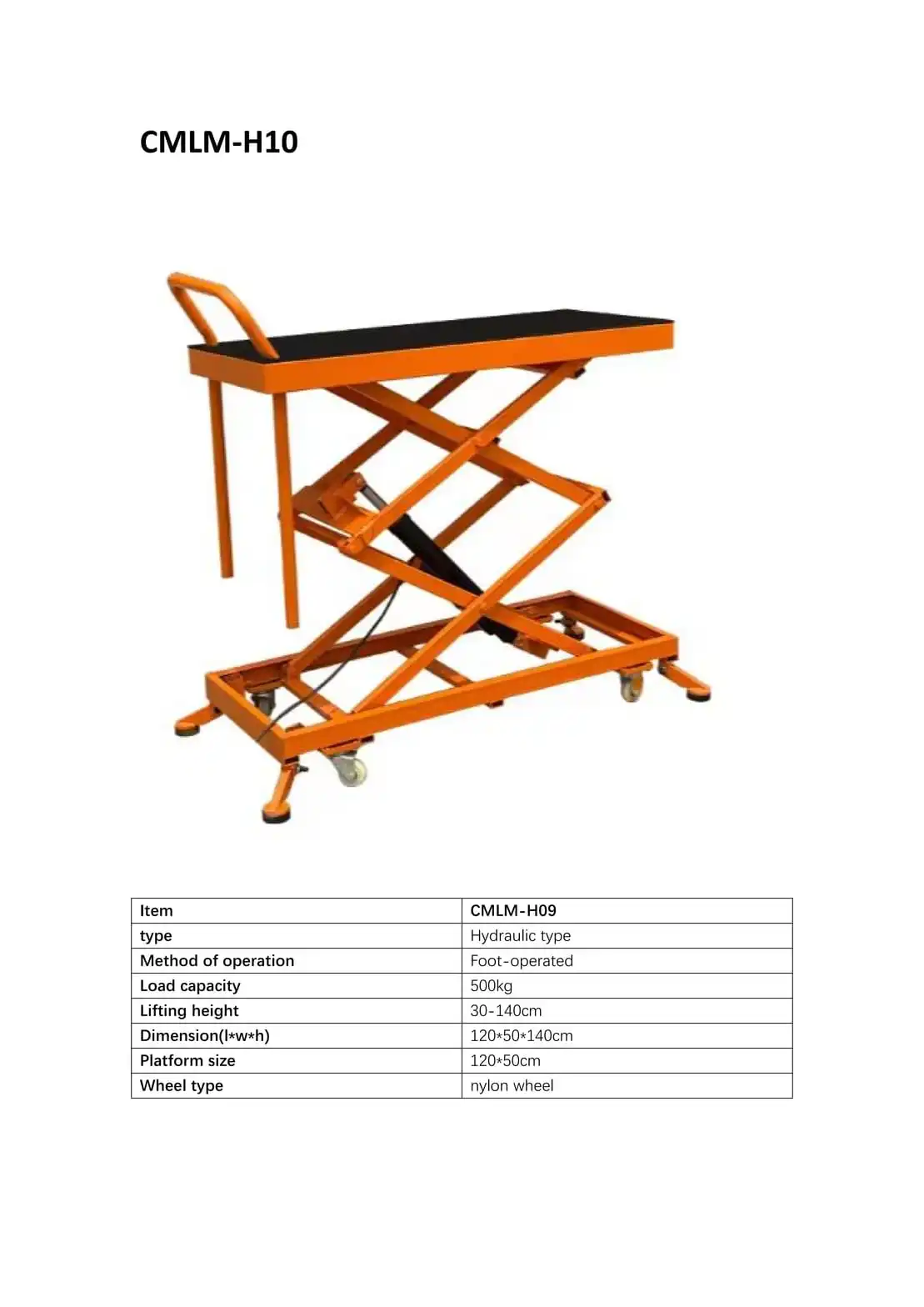
CMLM-H10
Hydraulic table lift
- Capacity: 500 kg
- Lift range: 30-40 cm
- Power/electrical data: not stated on product page
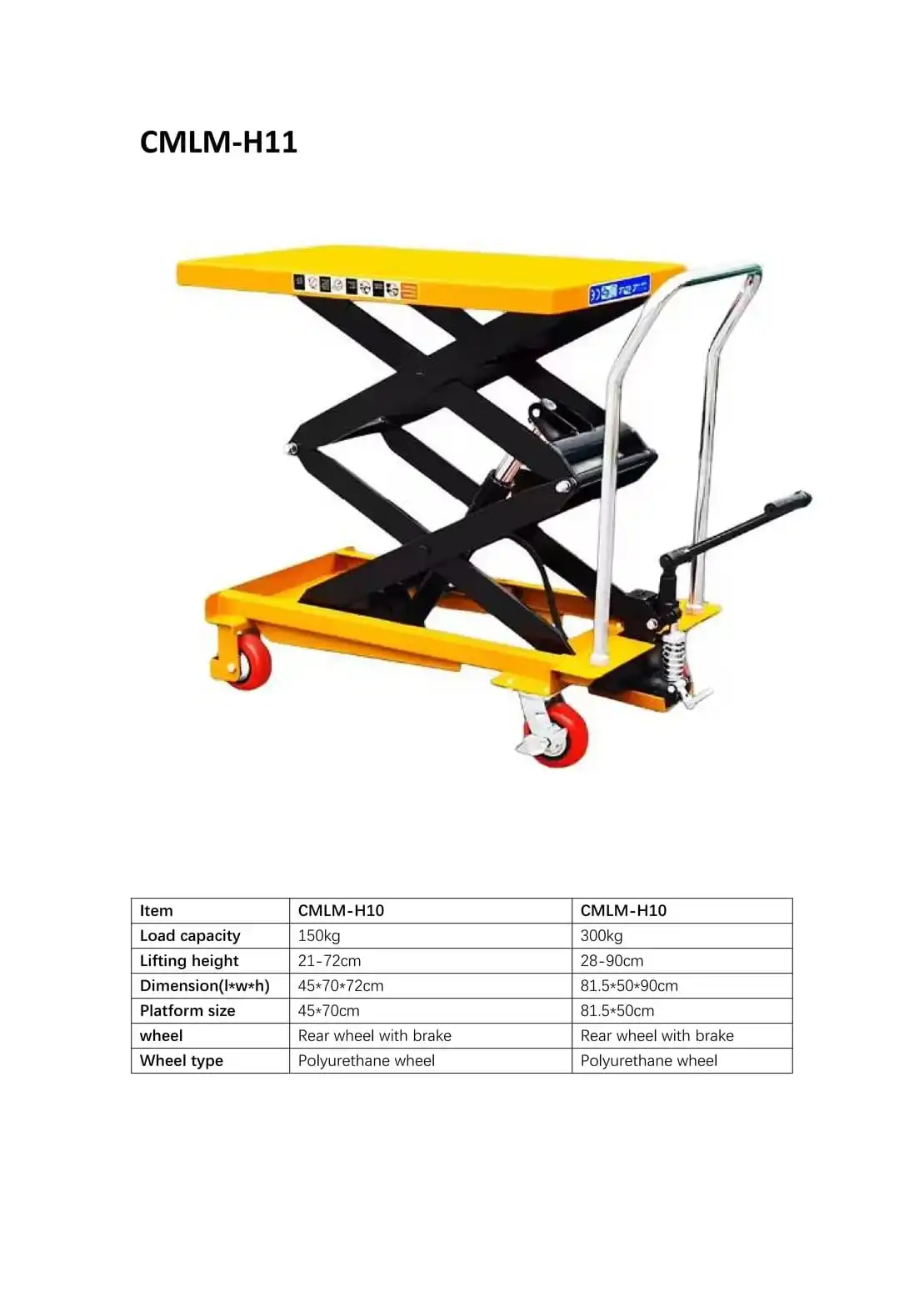
CMLM-H11
Hydraulic table lift
- Capacity: 150 / 300 kg
- Lift range: 21-22 cm / 28-30 cm
- Power/electrical data: not stated on product page
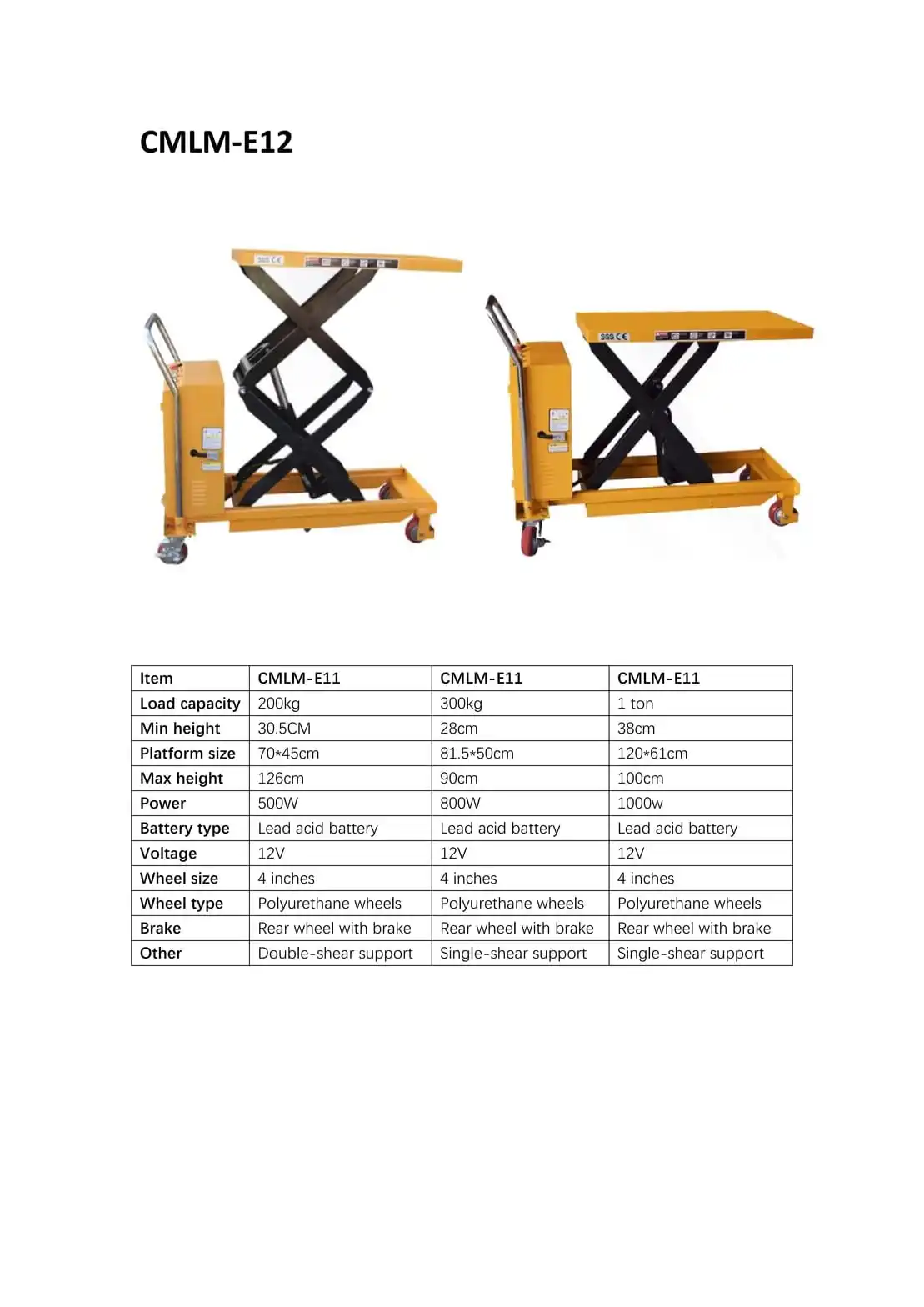
CMLM-E12
Electric table lift
- Capacity: 200 / 300 / 1000 kg
- Lift height: 126 / 90 / 100 cm
- Power: 500 / 800 / 1000 W
- Battery: 12V lead-acid
Frequently Asked Questions
What are the five core safety rules for a hydraulic lifting table?
Inspect the table before use, keep the load below the verified rated capacity, center and secure the load, keep people clear of the moving platform, and use the correct lockout and maintenance procedure before working underneath it.
What should I do if a hydraulic lifting table rises slowly or the platform shakes?
Stop using the table, lower and isolate it if safe, then check for overload, uneven loading, low or contaminated hydraulic fluid, visible hose leakage, loose fasteners and air in the hydraulic circuit. Do not continue operation until a qualified technician confirms the cause.
Which Chenma lifting-table specifications are verified?
The Chenma CMLM-H10 is rated at 500 kg with a 30-40 cm lift. The CMLM-H11 has 150 kg and 300 kg configurations with 21-22 cm and 28-30 cm lift ranges. The CMLM-E12 offers 200, 300 or 1000 kg capacities, 126, 90 or 100 cm lift heights, 12V lead-acid power and 500, 800 or 1000 W motor options.
How often should a hydraulic lifting table be maintained?
Perform a visual and functional check before every shift, clean and inspect key components weekly, and schedule a documented monthly inspection of hydraulic lines, fluid condition, safety devices, structure, fasteners and electrical components where fitted.
Disclaimer: This guide provides general safety and maintenance guidance. Always follow the specific operator manual, use qualified service personnel, isolate stored energy before service and comply with local workplace rules. Never work under a raised platform without approved mechanical support. Product specifications must be confirmed with Chenma before purchase.