Direct Answer
The 4 dimensions that decide an electric pallet truck
- Rated capacity. Select a rated load above the heaviest pallet, including uneven or shifting loads.
- Fork specifications. Check fork length, outside width, fork spacing and entry height against your pallet openings.
- Turning space. Measure aisle width, rack-end clearance, doorway width and the truck's turning radius before ordering.
- Battery runtime. Match battery voltage and amp-hours to shift length, route distance, load weight and charging access.
If the job includes rack storage or repeated vertical placement, compare a stacker as well. A floor-level pallet truck and a mast-equipped stacker are different tools.
Match the Truck to the Warehouse Scenario
Use the workflow, not a generic capacity label, to choose the right configuration.
| Scenario | What the truck must do | Selection priorities | Check before ordering |
|---|---|---|---|
| Warehouse replenishment | Move pallets from reserve stock to pick faces | Capacity margin, battery runtime, fork entry fit | Aisles, rack-end turns and shift duty cycle |
| Short-distance transfer | Move loads between nearby workstations | Compact turning envelope, controls, charging access | Doorways, floor joints and pedestrian separation |
| Loading and unloading zone | Transfer pallets across dock or staging area | Capacity, fork length, traction and floor clearance | Dock edge, ramp gradient and pallet condition |
| Narrow aisle | Position pallets where turning space is limited | Small turning radius, accurate controls, compact chassis | Minimum aisle width with a loaded pallet |
Electric Pallet Truck vs Manual Hand Pallet Truck vs Stacker
The correct comparison is about movement and height, not simply motor power.
| Criterion | Electric pallet truck | Manual hand pallet truck | Electric / semi-electric stacker |
|---|---|---|---|
| Primary job | Powered horizontal pallet movement | Occasional short horizontal movement | Horizontal movement plus vertical placement |
| Operator effort | Low travel effort; powered drive | Manual pushing and pumping | Powered lift; travel may be powered or assisted |
| Best environment | Frequent route work on level floors | Light duty and very short routes | Storage, rack access and elevated placement |
| Key risk | Speed, turns and battery state | Operator strain and poor load control | Elevated-load stability and mast clearance |
Forks, Turning Space and Battery: The Practical Fit Check
Forks
Measure pallet entry openings and load length. Forks should support the load evenly without excessive overhang. Ask for fork length, outside width, spacing and minimum entry height in writing.
Turning
Mark the narrowest aisle and make a loaded mock turn. Include the pallet's rear overhang, doorway clearance, rack-end space and pedestrian exclusion zone.
Runtime
Compare voltage and Ah with your duty cycle. Lithium batteries can support opportunity charging; lead-acid systems need a suitable charging area and planned charge time. Use the supplier's loaded-route estimate.
Lithium vs Lead-Acid: Choosing the Battery
| Factor | Lithium-ion | Lead-acid |
|---|---|---|
| Charging | Opportunity charging is practical when approved by the battery maker | Plan full charge cycles and a ventilated charging area |
| Shift pattern | Good for multi-shift routes with planned top-ups | Good for predictable single-shift duty and lower upfront cost |
| Maintenance | Usually less routine fluid maintenance | Requires correct charging practice and battery care |
| Selection rule | Choose when uptime and opportunity charging justify the investment | Choose when charging can be scheduled and acquisition budget is decisive |
Safe Operating Checklist
Inspect before use — forks, wheels, controls, emergency stop, battery and warning labels.
Confirm the load — weight, center of gravity, pallet condition and stable stacking.
Set the route — clear pedestrians, check ramps and keep visibility unobstructed.
Travel low and slow — keep forks/load low and reduce speed before turns.
Use the horn — signal at doorways, blind corners and intersections.
Park safely — lower forks fully, apply the brake and isolate power when unattended.
8 Questions to Ask a Supplier
Verified Chenma Pallet-Handling Equipment
The repository contains verified Chenma stacker pages, but no page explicitly named Electric Pallet Truck. The products below are therefore presented as verified pallet-workflow alternatives, not as electric pallet truck listings.
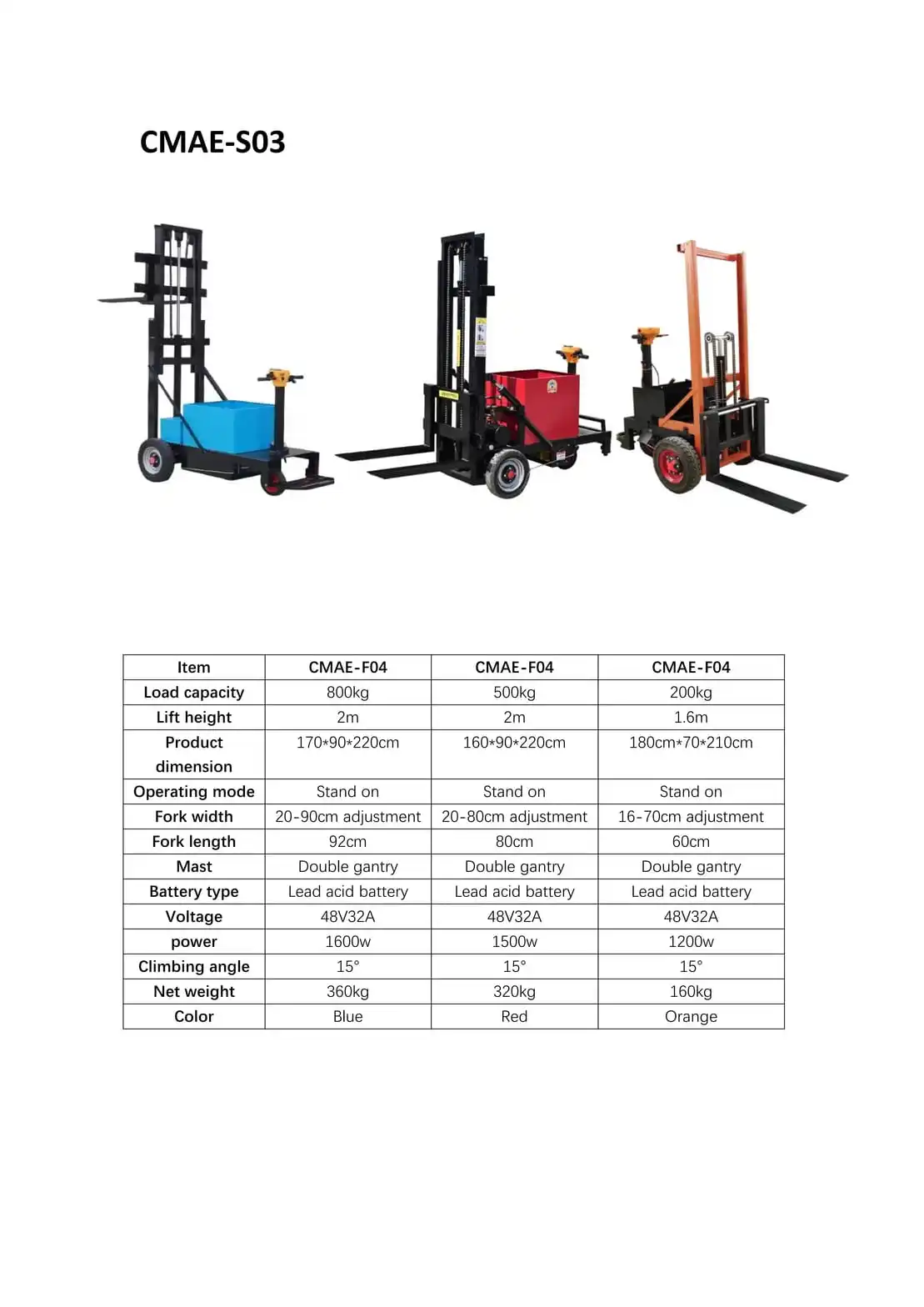
CMAE-F04 Stand-on Stacker
Verified mast-equipped option for pallet movement and vertical placement
- Capacity: 500 kg
- Lift height: 2 m
- Motor: 1500 W
- Battery: 48V / 32A lead-acid
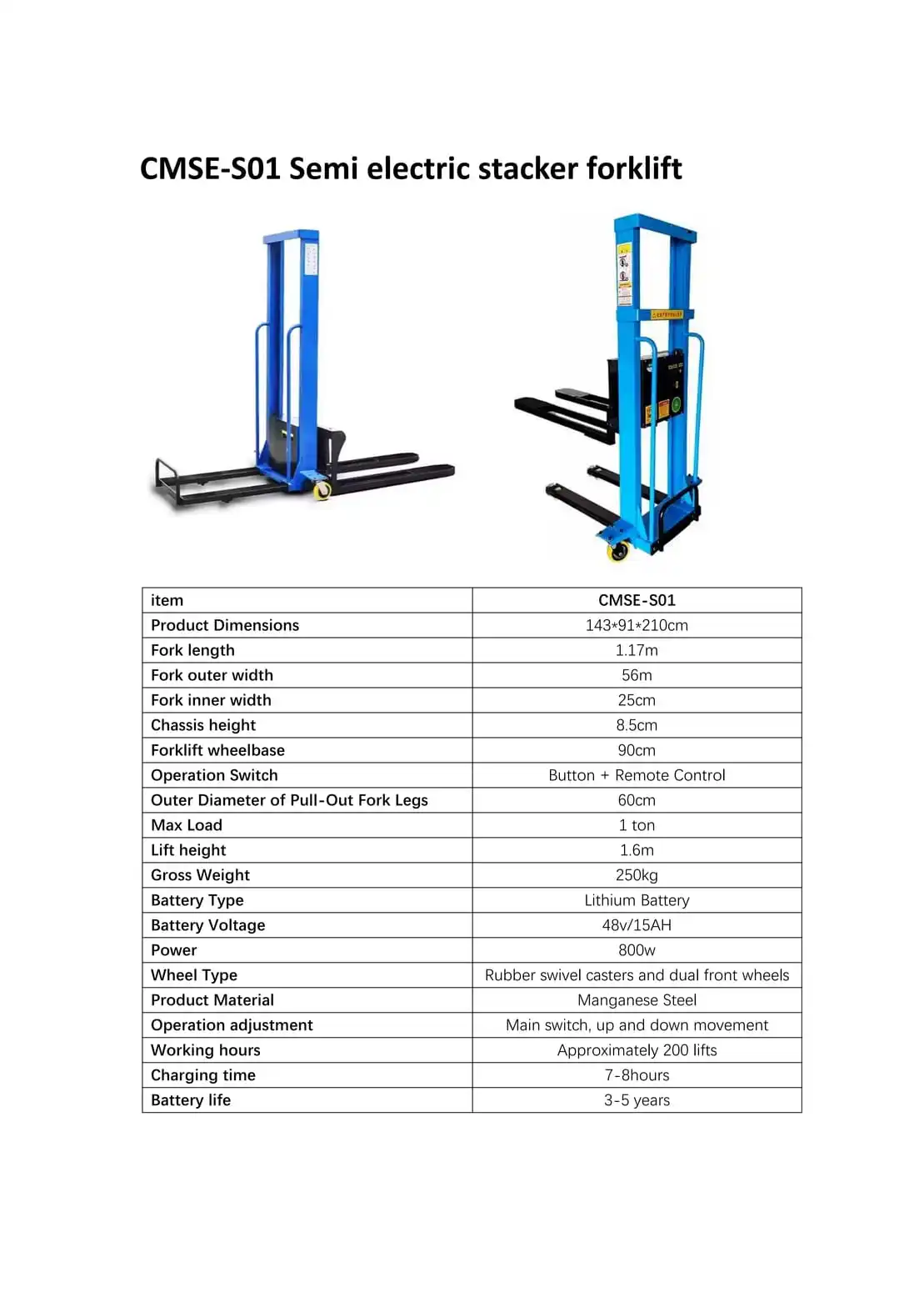
CMSE-S01 Semi-Electric Stacker
Verified lithium-powered option for pallet movement and 1.6 m placement
- Capacity: 1000 kg
- Lift height: 1.6 m
- Motor: 800 W
- Battery: 48V / 15AH lithium
Frequently Asked Questions
What four specifications should I compare when choosing an electric pallet truck?
Compare rated capacity, fork length and width, turning space, and battery runtime first. Then confirm lift height, charger compatibility, safety controls and service support for the intended warehouse route.
What is the difference between an electric pallet truck and a stacker?
An electric pallet truck is primarily for moving pallets horizontally at floor level. A stacker adds a mast for vertical lifting and storage. Select a pallet truck for short horizontal moves and a stacker when you must place loads on racks or at elevated positions.
Which Chenma stacker specifications are verified for pallet workflows?
The Chenma CMAE-F04 Stand-on Stacker is rated at 500 kg, lifts 2 m, uses a 48V / 32A lead-acid battery and has a 1500 W motor. The Chenma CMSE-S01 Semi-Electric Stacker is rated at 1000 kg, lifts 1.6 m, uses a 48V / 15AH lithium battery and has an 800 W motor.
How can I estimate electric pallet truck battery runtime?
Start with the battery voltage and amp-hour rating, then compare the result with your shift length, load weight, travel distance, floor condition and charging opportunities. Ask the supplier for a duty-cycle estimate based on your actual route rather than relying on an unloaded runtime claim.
Disclaimer: This guide provides general selection guidance. Always verify pallet dimensions, capacity, load center, turning space, battery duty cycle, floor conditions and safety devices with the equipment supplier before purchase. Follow the operator manual and local workplace rules. The verified Chenma products shown here are stackers; they are not being represented as electric pallet truck products.