Electric Forklift Safety Guide
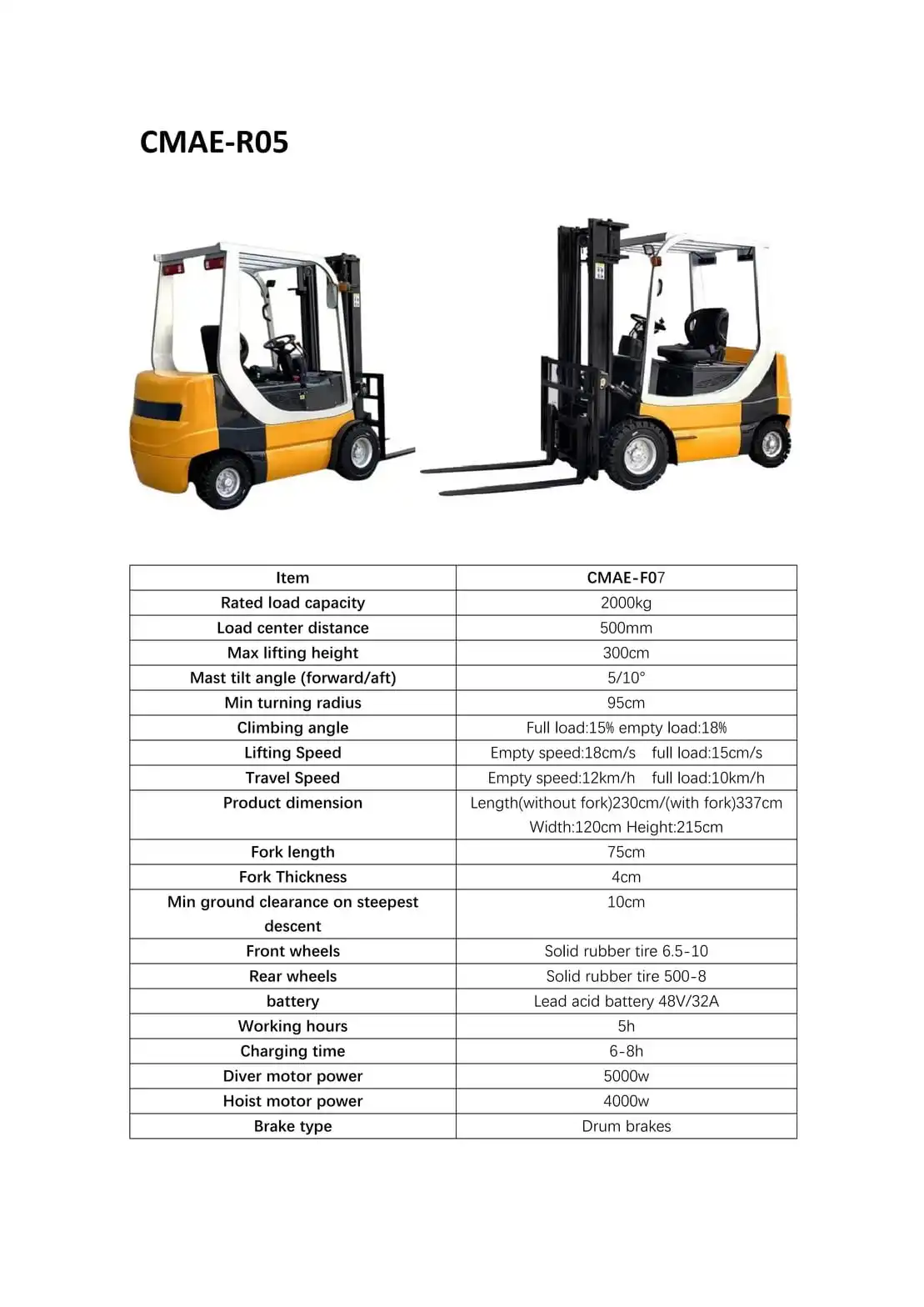
Electric forklifts move thousands of tons of goods every day, but a single careless moment - a missed brake check, an overloaded fork, a wet charging bay - can cause serious injury or costly damage. This guide covers the daily pre-shift checklist, correct charging practices for lithium and lead-acid batteries, driving and lifting standards, and the most common accidents with their prevention. It is written around real Chenma electric forklift models: CMAE-F07 (2000kg), CMAE-F02-1 (800kg) and CMAE-R10 (800kg).
Direct Answer: Core Safety Principles
Safe electric forklift operation rests on five habits: inspect before every shift, respect the rated load capacity, keep the load low while travelling, slow down at turns and ramps, and follow the correct charging procedure. When any of these is skipped, the risk of tipping, collision, dropped loads, or battery fires rises sharply.
Pre-Shift Daily 10-Point Inspection Checklist
Perform this check before the first shift every day, and record any defect before operating:
| # | Check Point | What to Verify |
|---|---|---|
| 1 | Brakes | Service and parking brake hold firmly; no sinking or dragging |
| 2 | Horn & warning devices | Horn, reversing alarm and lights all function |
| 3 | Hydraulic system | No visible leaks; mast raises and lowers smoothly |
| 4 | Tires | Correct pressure, no cuts, no debris embedded in tread |
| 5 | Battery charge & connections | Charge indicator in working range; terminals clean and tight |
| 6 | Forks & mast | Forks not bent or cracked; mast rails lubricated and aligned |
| 7 | Steering | Full travel without binding or excessive play |
| 8 | Lights | Headlights, tail lights and hazard lights work |
| 9 | Safety devices | Seat switch, emergency stop and overhead guard intact |
| 10 | Work area | Aisles clear, floor condition safe, fire extinguisher accessible |
Charging Safety: Lithium vs Lead-Acid
Chenma electric forklifts use two battery technologies. The CMAE-F07 (2000kg, 3m, 5000W) and CMAE-F02-1 (800kg, 2m, 1500W) run on 48V lead-acid batteries (32A and 52AH respectively), while the CMAE-R10 (800kg, 2m, 1500W brushless motor) uses a 48V 75AH lead-acid pack x4. Follow the rules below for either type:
Lead-Acid Charging Rules
- Charge only in a well-ventilated area - charging produces hydrogen gas
- Keep sparks and open flames away from the charging bay
- Connect the charger to the battery before plugging into the wall outlet
- Top up cells with distilled water only, after charging is complete
- Never charge on a wet or conductive floor surface
- Use the correct charger voltage for the 48V system
General Charging Rules (All Types)
- Follow the manufacturer's charging time - do not overcharge
- Do not charge a damaged or swollen battery pack
- Inspect cables and plugs for wear before connecting
- If you smell burning or see smoke, disconnect power and evacuate
- Keep a class D or appropriate fire extinguisher near the charging area
- Charge only when the truck is parked with the key off
Driving & Lifting Standards
Load Curve & Capacity
- Never exceed the rated capacity: the CMAE-F07 (5000W motor) carries up to 2000 kg, while the CMAE-F02-1 (1500W) and CMAE-R10 (1500W brushless motor) carry up to 800 kg. Overloading shifts the load center and destabilizes the truck.
- Lift height affects safe capacity - the higher the lift, the smaller the safe load at full height (CMAE-F07: 3m, CMAE-F02-1 / CMAE-R10: 2m).
- Center heavy loads on both forks and keep them level before lifting.
Turning & Speed
- Slow down before every turn - electric forklifts are rear-steered and can swing wide or tip at speed.
- Carry the load tilted back and low (100-150 mm above the ground) while travelling.
- Maintain a safe following distance; stop distances are longer with a load.
Ramp Operation
- Drive straight up and back down ramps; never turn across the slope.
- With a load, drive forward going up and reverse going down so the load faces uphill.
- Keep the forks low and the load secure; use the brake, not the motor, to control descent speed.
Common Accidents & Prevention
| Accident | Typical Cause | Prevention |
|---|---|---|
| Tipping over | Sharp turn at speed, overload, or load raised while turning | Keep load low; slow down; respect load curve |
| Collision | Blind corners, reversing without checking, distracted driving | Sound horn; use spotters; check mirrors before reversing |
| Dropped load | Unbalanced forks, damaged pallet, or tilting mast forward too early | Center the load; inspect pallets; tilt back before travel |
| Charging fire | Overcharging, damaged cables, sparks near hydrogen gas | Ventilate charging bay; inspect cables; follow charge times |
Frequently Asked Questions
What daily checks must be done before operating an electric forklift?
Check brakes, horn, hydraulic system, tires, battery charge level, forks and mast, steering, lights, warning devices, and the operator area for obstacles before every shift.
How should a lead-acid forklift battery be charged safely?
Charge in a well-ventilated area away from sparks, connect the charger before plugging into the wall, never charge on a wet floor, and top up electrolyte with distilled water after charging.
What is the load capacity of the Chenma CMAE-F07 electric forklift?
The Chenma CMAE-F07 Heavy Duty electric forklift has a load capacity of 2000 kg with a lift height of 3 m, powered by a 5000W motor and a 48V lead-acid battery.
How do I drive an electric forklift safely on a ramp?
Drive straight up and back down ramps with the load facing uphill, keep the forks low, never turn across the slope, and always maintain control of the load at all times.
Safety disclaimer: This guide provides general industry practices for operating electric forklifts. Always follow the operator's manual of your specific equipment, complete certified operator training, and comply with local workplace safety regulations. When in doubt, stop the truck and consult a qualified technician.